



Pocket WiFi or eSIM — which one is actually worth it for Vietnam travel? For most solo travelers and couples: eSIM is cheaper and simpler. For groups sharing one connection: pocket WiFi can make more sense financially.
Here’s how to figure out which fits your trip.
I. What each option actually is
1. Pocket WiFi
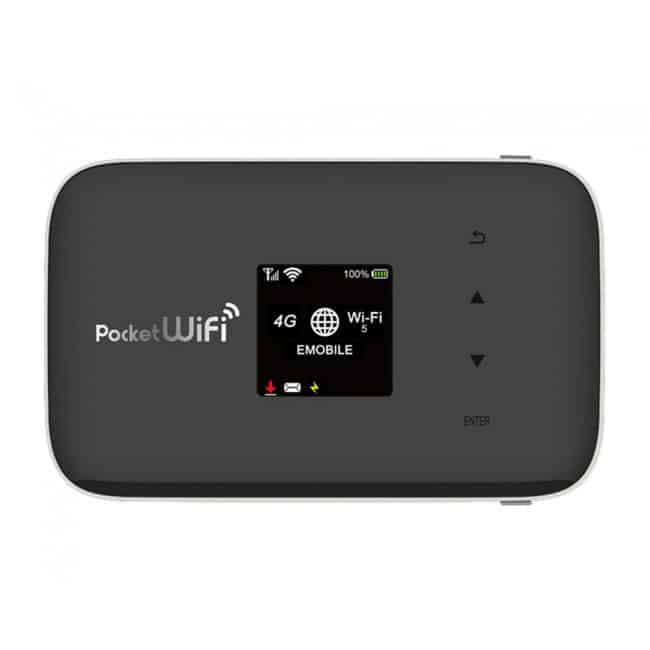
A pocket WiFi is a small physical device — about the size of a credit card — that you carry with you. It has a SIM card inside that connects to Vietnam’s mobile networks (Viettel, Vinaphone, Mobifone), then broadcasts a private WiFi signal that your phone, laptop, or tablet can connect to.
Most rental models support 5–15 devices at once and run on a battery lasting 6–10 hours per charge.
You rent or buy a physical device, carry it throughout your trip, and return it at the end of your trip.
2. eSIM
An eSIM is a digital SIM card — no physical chip, no device to carry. Instead of inserting a card into your phone, you scan a QR code and the data plan is installed directly onto your phone. When you land in Vietnam, your phone connects to the local network automatically.
eSIM works on iPhone XR and later, Samsung Galaxy S20 and later, Google Pixel 3 and later, and most flagship phones released after 2020. Your phone also needs to be unlocked.
→ Check if your phone supports eSIM
II. Quick comparison: pocket WiFi vs. eSIM for Vietnam travel
| Criteria | Pocket WiFi | eSIM |
| Daily cost (solo) | $4–8/day | ~$1.50–2/day |
| Setup | Pick up on arrival | Install before you fly |
| Passport required | Usually yes | No (online providers) |
| Devices connected | Up to 15 | 1 (your phone only) |
| Battery dependency | ✅ Needs charging | ❌ None |
| Deposit required | ✅ $50–120 | ❌ None |
| Works in rural areas | Depends on SIM inside device | Depends on network chosen |
| Late-night airport arrival | Counter may be closed | Works anytime |
| Phone number included | ❌ No | Depends on plan |
III. How much does each option cost?
The price difference between the two options changes significantly depending on your group size.
| Group size | Pocket WiFi | eSIM | Winner |
| Solo traveler (10 days) | ~$60 rental + $50–120 deposit | $13.9 total | eSIM by ~$46 |
| Couple (10 days) | ~$60 shared + deposit | $27.80 total | eSIM by ~$32 |
| Group of 4 (10 days) | ~$15/person | ~$13.90/person | About equal |
| Group of 6+ (10 days) | ~$10/person | ~$13.90/person | Pocket WiFi wins |
Note: The deposit ($50–120) is refunded when you return the device, but it ties up your cash for the entire trip. Airport providers tend to charge higher deposits and have stricter return policies than city rental shops.
→ For the full breakdown of deposit rules, hidden fees, and penalty charges, see our Pocket WiFi Deposit Vietnam guide.
IV. When pocket WiFi is the better choice
1. Your group has devices that don’t support eSIM
Older phones, most budget Android devices, and laptops cannot use eSIM. If even one person in your group is using a non-eSIM device, a shared pocket WiFi connection means everyone stays connected without anyone needing to buy extra equipment. One device, one plan, split the cost.
2. You’re traveling in a large group
As the cost table above shows, once you have 6 or more people sharing a single pocket WiFi, the per-person cost drops to roughly $1/day — well below what individual eSIM plans would cost. The math tips in pocket WiFi’s favor at that group size.
3. You need internet on a laptop all day without a charging point
Using your phone as a hotspot while simultaneously running Google Maps drains an iPhone 15 battery roughly twice as fast as normal use. If you’re working on a laptop for long stretches — on overnight trains, in cafes without power sockets — a pocket WiFi with its own dedicated 5,350 mAh battery (typical for Vietnam rental devices) is a more reliable setup than relying on your phone.
V. When eSIM is the better choice
1. You’re traveling solo or as a couple and want to save money
For 1–2 travelers, eSIM is significantly cheaper.
- A 15-day Vietnam eSIM plan costs $13.90 from vietnamesim.com.
- A 10-day pocket WiFi rental costs $60 in rental fees alone — before the $50–120 deposit.
Even after the deposit is refunded, you’ve spent 3–4x more than an eSIM would have cost for similar or better data.
2. You don’t want to deal with pickup, return, and deposit logistics
With a pocket WiFi, you need to find the rental counter at the airport (which can mean a 20–30 minute detour after a long flight), keep the device charged every day, carry it everywhere, make sure it doesn’t get lost or damaged, and return it before you leave. With an eSIM, you scan a QR code at home before your trip, and your phone connects automatically when you land. No counter, no return, no deposit.
3. You’re arriving late at night
Pocket WiFi counters at Vietnamese airports close in the evening . If you’re arriving on a late-night or early-morning flight, there may simply be no rental options available. eSIM has no counter and no opening hours. It activates the moment your phone connects to a Vietnamese network, regardless of what time you land.
→ Late night arrival in Vietnam: Connectivity guide
4. You’re heading to Ha Giang, Sapa, or other remote areas
This is a point most rental providers don’t advertise: pocket WiFi performance in rural areas depends entirely on which SIM card is inside the device.
Many rental companies use Mobifone or cheaper MVNO networks to keep costs down. If your pocket WiFi is running on MobiFone, you may lose signal on the Ha Giang Loop or in deep Sapa valleys.
A Viettel eSIM consistently outperforms pocket WiFi on budget networks in these areas because Viettel has the strongest rural infrastructure in Vietnam.
Tip: Before renting any pocket WiFi for a rural trip, ask specifically which network the SIM inside uses — don’t accept “4G nationwide coverage” as an answer.
VI. Can I use my phone as a hotspot instead of renting pocket WiFi?
Yes — and for most travelers, this is the practical middle ground. Most Vietnam eSIM plans support mobile hotspot/tethering features.
The main limitation is battery. Running a hotspot and navigation at the same time drains an iPhone 15 roughly twice as fast as normal use.
For most day trips around cities or tourist areas, a power bank solves this easily. For full-day travel in areas without power sockets — overnight buses, remote trekking — a separate pocket WiFi with its own battery is more practical.
→ How to share mobile hotspot in Vietnam
VII. Where to rent pocket WiFi in Vietnam
If pocket WiFi is the right option for your trip, here’s where to get one:
1. At Vietnam airports
Counters are available at Noi Bai (Hanoi), Tan Son Nhat (HCMC), Da Nang, and Cam Ranh (Nha Trang) airports. Easy to access on arrival, but prices are slightly higher than online rental and counters may close late at night.
2. Online rental (delivered to hotel or home)
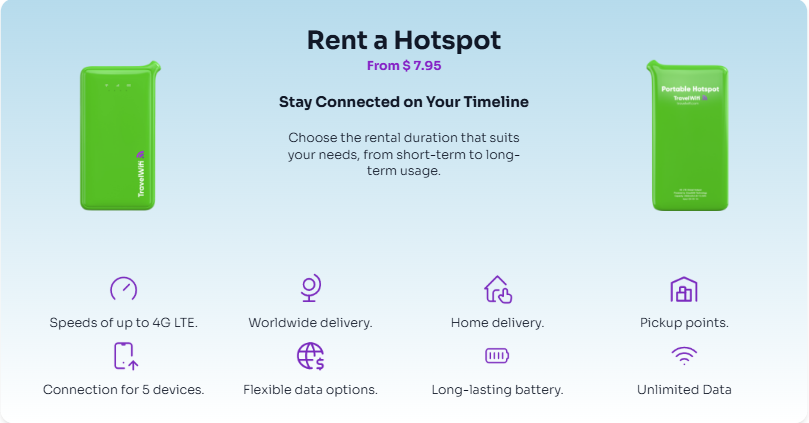
- TravelWifi — $7.95–12.95/day depending on data allowance (1–5GB/day). Ships internationally before your trip.
- MioWifi — $8/day, unlimited 4G. Delivers to your hotel in Vietnam.
- Solis — from $5/day after buying the device ($159). Includes optional VPN service.
- My Webspot — ~$10.90/day, capped at 3GB/day. Not suitable for heavy users.
Price range: $4–13/day for rental. Deposits range from $50–120 depending on provider and pickup location.
VIII. Best Vietnam eSIM plans as alternative to Pocket WiFi
If eSIM is the right option for your trip, plans are available for all three major Vietnamese networks — no passport required, QR code delivered by email in 3–5 minutes.
| Network | Validity | Data | Vietnamese number | Price |
| Viettel | 7 / 15 / 30 days | 5GB/day | ❌ No | from $10.90 |
| Vinaphone | 7 / 10 / 15 / 30 days | 2–5GB/day | ✅ Yes | from $10.90 |
| Mobifone | 7–30 days | 3-8GB/day | ✅ Yes | from $7.90 |
IX. Quick table for decision
| Considerations | Recommended option |
| Traveling solo or as a couple? | eSIM — cheaper, no deposit, no hassle |
| Phone doesn’t support eSIM? | Physical SIM card is simpler than pocket WiFi for one person |
| Traveling in a group of 4+ with mix of phones + laptops? | Pocket WiFi splits cost well |
| Traveling in a group of 4+ and everyone has eSIM phones? | Individual eSIMs likely cheaper – check the per-person math |
| Arriving late at night? | eSIM only — counters may be closed |
| Going to Ha Giang or Sapa? | Viettel eSIM more reliable than pocket WiFi on unknown network |
| Need laptop WiFi for full days? | Pocket WiFi worth considering |